diceware
v1.0.1Passphrases you will remember
$ uv add dicewarediceware
Passphrases to remember...
 | documentation | sources | issues
diceware is a passphrase generator following the proposals of Arnold G. Reinhold on http://diceware.com . It generates passphrases by concatenating words randomly picked from wordlists. For instance::
$ diceware MyraPend93rdSixthEagleAid
The passphrase contains by default six words (with first char capitalized) without any separator chars. Optionally you can let diceware insert special chars into the passphrase.
diceware supports several sources of randomness (including real life dice) and different wordlists (including cryptographically signed ones).
Install
This Python package can be installed via pip_:
$ pip install dicewareThe exact way depends on your operating system.
Usage
Once installed, use --help to list all available options:
$ diceware --help
usage: diceware [-h] [-n NUM] [-c | --no-caps] [-s NUM] [-d DELIMITER]
                [-r SOURCE] [-w [NAME [NAME ...]]] [--dice-sides N] [-v]
                [--version]
                [INFILE]

Create a passphrase

positional arguments:
  INFILE                Input wordlist. `-' will read from stdin.

optional arguments:
  -h, --help            show this help message and exit
  -n NUM, --num NUM     number of words to concatenate. Default: 6
  -c, --caps            Capitalize words. This is the default.
  --no-caps             Turn off capitalization.
  -s NUM, --specials NUM
                        Insert NUM special chars into generated word.
  -d DELIMITER, --delimiter DELIMITER
                        Separate words by DELIMITER. Empty string by default.
  -r SOURCE, --randomsource SOURCE
                        Get randomness from this source. Possible values:
                        `realdice', `system'. Default: system
  -w [NAME [NAME ...]], --wordlist [NAME [NAME ...]]
                        Use words from this wordlist. Possible values: `ca`,
                        `de', `de_8k', `en_adjectives', `en_eff', `en_nouns',
                        `en_securedrop', `es`, `fr`, `it`, `pt-br'.
                        Wordlists are stored in the folders displayed below.
                        Default: en_eff
  -v, --verbose         Be verbose. Use several times for increased verbosity.
  --version             output version information and exit.
  --show-wordlist-dirs  Output directories we look up to find wordlists and exit.

Arguments related to `realdice' randomsource:
  --dice-sides N        Number of sides of dice. Default: 6

Use --show-wordlist-dirs to list directories where you can store custom wordlists.
With -n you can tell how many words are supposed to be picked for your new passphrase::
$ diceware -n 1 Thud
$ diceware -n 2 KnitMargo
You can diceware additionally let generate special chars to replace characters in the 'normal' passphrase. The number of special chars generated can be determined with the -s option (default is zero)::
$ diceware -s 2 Heroic%unkLon#DmLewJohns
Here "%" and "#" are the special chars.
Special chars are taken from the following list:
~!#$%^&*()-=+[]\{}:;\"'<>?/0123456789Please note that several special chars might replace the same original char, resulting in a passphrase with less special chars than requested.
With -d you can advise diceware to put a delimiter string between the words generated::
$ diceware -d "_" Wavy_Baden_400_Whelp_Quest_Macon
By default we use the empty string as delimiter, which is good for copying via double click on Linux systems. But other delimiters might make your passphrases more readable (and more secure, see Security Traps below).
By default the single phrase words are capitalized, i.e. the first char of each word is made uppercase. This does not necessarily give better entropy (but protects against entropy loss due to non prefix code_, see Security Traps below), and it might improve phrase readability.
You can nevertheless disable caps with the --no-caps option:
$ diceware --no-caps
oceanblendbaronferrylistenvalet
This will leave the input words untouched (upper-case stays upper-case, lower-case stays lower-case). It does not mean, that all output words will be lower-case (except if all words of your wordlist are lowercase).
As the default lists of diceware contain only lower-case terms, here --no-caps means in fact lower-case only output, which might be easier to type on smart phones and similar.
diceware supports also different sources of randomness, which can be chosen with the -r <SOURCENAME> or --randomsource <SOURCENAME> option. Use the --help option to list all valid values for this option.
By default we use the random.SystemRandom_ class of standard Python lib but you can also bring your own dice to create randomness::
$ diceware -r realdice --dice-sides 6 Please roll 5 dice (or a single dice 5 times). Enter your 5 dice results, separated by spaces: 6 4 2 3 1 Please roll 5 dice (or a single dice 5 times). Enter your 5 dice results, separated by spaces: 5 4 3 6 2 ... UnleveledSimilarlyBackboardMurkyOasisReplay
Normally dice have six sides. And this is also the default in diceware if you do not use --dice-sides. But if you do, you can tell how many sides (all) your dice have. More sides will lead to less rolls required.
diceware comes with an English wordlist provided by the EFF_, which will be used by default and contains 7776 (=6^5) different words. This list is registered as en_eff.
Additionally diceware comes with an English wordlist provided by @heartsucker_, which contains 8192 different words. This list is based off the original diceware list written by Arnold G. Reinhold.
You can enable a certain (installed) wordlist with the -w option:
$ diceware --wordlist en_orig
YorkNodePrickEchoToriNiobe
See diceware --help for a list of all installed wordlists.
You can also build phrases from adjectives and nouns (yet in english only) using the included en_adjectives and en_nouns lists. For that you specify these two wordlists after each other::
$ diceware -n 1 -w en_adjectives en_nouns TediousPerimeter
These adjective/noun phrases might be easier to memorize.
If you do not like the wordlists provided, you can use your own one. Any INFILE provided will be parsed line by line and each line considered a possible word. For instance::
$ echo -e "hi\nhello\n" > mywordlist.txt $ diceware mywordlist.txt HelloHelloHiHiHiHello
With dash (-) as filename you can pipe in wordlists:
$ echo -e "hi\nhello\n" | diceware -
HiHiHelloHiHiHello
In custom wordlists we take each line for a valid word and ignore empty lines (i.e. lines containing whitespace characters only). Oh, and we handle even PGP-signed wordlists.
You can set customized default values in a configuration file .diceware.ini (note the leading dot) placed in your home directory. Since version 1.0 you can also use ${XDG_CONFIG_HOME}/diceware/diceware.ini or ${HOME}/.config/diceware/diceware.ini (if ${XDG_CONFIG_HOME} is undefined, see XDG_ for details).
This file could look like this:
[diceware]
num = 7
caps = off
specials = 2
delimiter = "MYDELIMITER"
randomsource = "system"
wordlist = "en_securedrop"
The options names have to match long argument names, as output by --help. The values set must meet the requirements valid for commandline usage. All options must be set within a section [diceware].
What is it good for?
Normally, diceware passphrases are easier to remember than shorter passwords constructed in more or less bizarre ways. But at the same time diceware passphrases provide more entropy as xkcd_ can show with the famous '936' proof_:
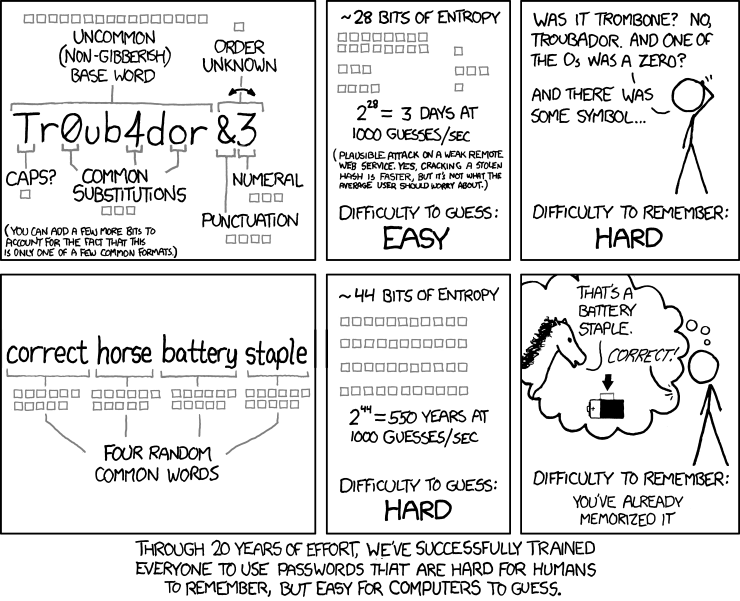
The standard english wordlist of this diceware implementation contains 7776 = 6^5 different english words. It is the official EFF_ wordlist. compiled by Joseph Bonneau_. Therefore, picking a random word from this list gives an entropy of nearly 12.9 bits. Picking six words means an entropy of 6 x 12.9 = 77.54 bits.
The special chars replacing chars of the originally created passphrase give some more entropy (the more chars you have, the more additional entropy), but not much. For instance, for a sixteen chars phrase you have sixteen possibilities to place one of the 36 special chars. That makes 36 x 16 possibilities or an entropy of about 9.17 you can add. To get an entropy increase of at least 10 bits, you have to put a special char in a phrase with at least 29 chars (while at the same time an additional word would give you 13 bits of extra entropy). Therefore you might think again about using special chars in your passphrase.
Is it secure?
The security level provided by Diceware_ depends heavily on your source of random. If the delivered randomness is good, then your passphrases will be very strong. If instead someone can foresee the numbers generated by a random number generator, your passphrases will be surprisingly weak.
This Python implementation uses (by default) the random.SystemRandom_ source provided by Python. On Un*x systems it accesses /dev/urandom. You might want to follow reports about manipulated random number generators in operating systems closely.
The Python API of this package allows usage of other sources of randomness when generating passphrases. This includes real dice. See the -r option.
Security Traps
There are issues that might reduce the entropy of the passphrase generated. One of them is the prefix code_ problem:
Prefix Code
If the wordlist contains, for example, the words:
"air", "airport", "portable", "able"and we switched off caps and delimiter chars, then diceware might generate a passphrase containing::
"airportable"
which could come from air-portable or airport-able. We cannot tell and an attacker would have less combinations to guess.
To avoid that, you can leave caps enabled (the default), use any word delimiter except the empty string or use the en_eff wordlist, which was checked to be a prefix code_ (i.e. it does not contain words that start with other words in the list). The pt-br is also a secure prefix code_.
Each of these measures is sufficient to protect you against the prefix code_ problem.
Reduced Entropy
Overall, diceware is a kind of mapping input values, dice throws for instance, onto wordlist entries. We normally want each of the words in the wordlist to be picked for passphrases with the same probability.
This, however, is not possible, if the number of wordlist entries is not a power of dice sides. In that case we cut some words of the wordlist and inform the user about the matter. Reducing the number of words this way makes it easier for attackers to guess the phrase picked.
You can fix that problem by using longer wordlists.
Developer Install
Developers want to fork me on github_:
$ git clone https://github.com/ulif/diceware.gitWe recommend to create and activate a virtualenv_ first:
$ cd diceware/
$ virtualenv -p /usr/bin/python3.11 py311
$ source py311/bin/activate
(py311) $
We support Python versions 2.7, 3.4 to 3.12, and pypy3.
Now you can create the devel environment:
(py311) $ pip install '.[tests,dev]'This will fetch test packages (py.test_), ruff as linter, black as code formatter and coverage. You should be able to run tests now::
(py311) $ pytest
If you have also different Python versions installed you can use tox_ for using them all for testing::
(py311) $ pip install tox # only once (py311) $ tox
Should run tests in all supported Python versions, the linter (ruff), coverage tests and more.
Documentation Install
The docs can be generated with Sphinx_. The needed packages are installed via::
(py311) $ pip install '.[docs]'
To create the docs as HTML in a directory of your choice, then run:
(py311) $ sphinx-build docs/ mydir/You can also change to the docs/ directory and use the prepared Makefile::
(py311) $ cd docs/ (py311) $ make
This should generate the docs in docs/_build/html/.
Creating the Man Page
We provide a ReStructuredTexT_ template to create a man page. When the documentation engine is installed (Sphinx_, see above), then you can create a manpage doing::
(py311) $ rst2man.py docs/manpage.rst > diceware.1
The template is mainly provided to ease the job of Debian maintainers. Currently, it is not automatically updated. Dates, authors, synopsis, etc. have to be updated manually. Information in the manpage may therefore be wrong, outdated, or simply misleading.
Credits
Arnold G. Reinhold deserves all merits for the working parts of Diceware_. The non-working parts are certainly my fault.
People that helped spotting bugs, providing solutions, etc.:
- Conor Schaefer (conorsch)
- Rodolfo Gouveia suggested to activate the
--delimiteroption. @drebs_ provided patches and discussion for different sources of
randomness and the excellent pt-br wordlist. @drebs_ also initiated and performed the packaging of diceware for the Debian_ platform. Many kudos for this work! @drebs_ is also the official Debian maintainer of the diceware package.
@heartsucker_ hand-compiled and added a new english wordlist.- dwcoder revealed and fixed bugs
#19, #21, #23. Also showed sound knowledge of (theoretical) entropy. A pleasure to work with.
- George V. Reilly pointed to new
EFF wordlists.
- lieryan brought up the `prefix
code`_ problem.
- LogosOfJ discovered and fixed
serious realdice source of randomness problem.
- Bhavin Gandhi fixed the confusing error
message when an invalid input filename is given.
- Simon Fondrie-Teitler contributed a
machine-readable copyright file, with improvements from @anarcat_
- Doug Muth fixed formatting in docs.
@kmille_ suggested support for XDG config file locations.Tangoprovided the french wordlist, also provided forTails OS_ and the
Tor Project_.
@jawlenskys_ provided the catalan, spanish and italian wordlists, also
provided for Tails OS_ and the Tor Project_.
Many thanks to all of them!
Links
- The Diceware_ home page. Reading definitely recommended!
fork me on github_
External Wordlists:
Diceware standard list_ by Arnold G. Reinhold.Diceware8k list_ by Arnold G. Reinhold.Diceware SecureDrop list_ by@heartsucker_.EFF large list_ provided by EFF_.English adjectives and nouns lists_ provided byNaturalLanguagePasswords_.
License
This Python implementation of Diceware, (C) 2015-2024 Uli Fouquet, is licensed under the GPL v3+. See file LICENSE for details.
"Diceware" is a trademark of Arnold G Reinhold, used with permission.
The copyright for the Diceware8k list_ is owned by Arnold G Reinhold. The copyright for the Diceware SecureDrop list_ are owned by @heartsucker_. Copyright for the EFF large list_ by Joseph Bonneau_ and EFF_. Copyright for the brazilian portuguese list by @drebs_. Copyright for the english adjective and noun lists by NaturalLanguagePasswords_. See file COPYRIGHT for details.
Changes
1.0.1 (2024-12-24)
Security Upgrade.
- Update dependency list for generating docs. The old dependencies required
an unsafe version of jinja2.
1.0 (2024-12-24)
Major overhaul of the whole project. We introduce more modern approaches in project layout (like pyproject), use new linters and other tools while we still support all Python versions from 2.7 up to current 3.12.
We now follow the XDG base directory specification, that tells where config (and other) files for an application can be found. You now can also use ${XDG_CONFIG_HOME}/diceware/diceware.ini, or, if the given var is emtpy or unset, ${HOME}/.config/diceware/diceware.ini. The traditional location ${HOME}/.diceware.ini is still supported.
Furthermore we read ${XDG_DATA_HOME}/diceware/ (or ${HOME}/.local/share/diceware/ if ${XDG_DATA_HOME} is empty or unset) to lookup further wordlists.
New option --show-wordlist-dirs lists all directory locations we search for contained wordlists.
- Officially support Python 3.10 to 3.12.
- Fixed #86: Follow XDG base directory specification.
- Fixed #84: Allow to store wordlists also in custom directories.
- Use
ruffas linter, dropflake8. - Renew
toxconfiguration. - Switch to
pyproject-based project layout, away from usingsetup.py. - Fixed #62: Removed
pkg_resourcesdependency. Kudos to @htgoebel!
As a side effect no randomness sources from other packages are supported anymore.
- Added French wordlist. Many thanks for the good work go to Tango.
- Added Catalan, Spanish and Italian wordlists.
0.10 (2022-02-15)
- Officially support Python 3.8 and Python 3.9.
- Removed official support for pypy2, Python 2.6, and Python 3.3.
- Allow to specify several wordlists in order to create syntactical valid
phrases.
- Also added first wordlists with english adjectives/nouns to generate for
instance <adjective-noun> phrases that are easier to memorize.
- When using real dice, allow entering of several rolls at once. Patch from
- Added german wordlists.
- Added carefully compiled brazilian portugese wordlist. Kudos to @drebs.
- Removed original diceware wordlists temporarily, for containing bad terms (#85)
0.9.6 (2018-12-19)
- Officially support Python 3.7.
- Fixed #51: Fix to formatting of list in Wordlists section. Kudos to `Doug
Muth <https://github.com/dmuth>`_.
0.9.5 (2018-04-07)
- Fixed #28: use Debian-compliant, machine-readable copyright format. Kudos to
Simon Fondrie-Teitler and @anarcat.
- Fixed #48: Clarify trademark status of diceware. Mr. Reinhold granted
permission to use the name 'Diceware' in this project and under the conditions listed in the issue comments. Many thanks to him!
0.9.4 (2018-02-27)
- Set default logging level to ERROR (was: CRITICAL)
- Fixed #44: provide a short and readable file-not-found message (many thanks to
- Fixed #45: clean up logging handlers after test runs.
- Removed date-dependent tests from default test suite. Run
py.test -m ''
or tox to run them.
0.9.3 (2017-09-14)
- Fix broken test.
0.9.2 (2017-09-14)
- Fixed #33. Make
en_effthe new default wordlist. This results in slightly
decreased entropy per word (12.92 bits instead of 13.0), but provides prefix code and better memorizable words. Thanks to @anarcat for the suggestion.
- Fixed #35. Make
realdicesource of randomness provide an equal distribution
of roll numbers even for sequences shorter than number of dice sides.
- Added a man page.
- Support Python 3.6.
- Import
ConfigParserinstead ofSafeConfigParserif the latter is an alias
of the former.
- Fixed #37. Ensure file descriptors are closed properly.
- Fixed #38. Get wordlists dir by function (instead of const) to allow
reproducible builds. Kudos go to @drebs, again.
0.9.1 (2016-12-24)
- Fixed #32, in docs tell that
--no-capsoption does not generate
lower-case terms.
- Fixed #31, broken
realdicesource of randomness.argparserelated bug,
Bug was discovered and fixed by @LogosOfJ, thanks a lot!
- Fixed #29. Tell about code prefix problem in README.
- Activated logging. Using
verbosewill result in additional output.
0.9 (2016-09-14)
- Added
--dice-sidesoption to tell how many sides used dices
provide.
- Changed API interface of
get_config_dict()to allow more flexible
handling of config files.
- Support different verbosity levels.
- Added new wordlist
en_eff. It is a 7776-terms list provided by
the Electronic Frontier Foundation. See https://www.eff.org/deeplinks/2016/07/new-wordlists-random-passphrases for details. Thanks to George V. Reilly for hinting!
- Fixed #27. Allow dashes in numbered wordlists. Yet, these looked
like 1234 myterm. We now also accept 1-2-3-4 myterm.
0.8 (2016-05-07)
- Closed #23. @dwcoder provided a fix that allows use of
whitespace-only values in diceware config files if they are enclosed in quotes.
- Fixed #21. @dwcoder revealed and fixed (again!). This time
--caps
and --no-caps settings did not work properly when set in CLI or in .diceware.ini config file.
- Shortened real-dice randomness source.
- Added logger as common interface to send messages to users.
- New dependency:
sphinx_rtd_themefor generating docs. This theme
was formerly a dependency of Sphinx.
0.7.1 (2016-04-21)
- Fixed #19. @dwcoder revealed and fixed a nasty bug in the real-dice
randomness-source. Thanks a lot!
0.7 (2016-04-17)
- Added sample
.diceware.ini. - Added new english wordlist
en_securedrop. This is the new
default list. Thanks to heartsucker who compiled and added the list.
- Remove support for Python 3.2. Several packages we depend on for testing
and sandboxing stopped Python 3.2 support. We follow them.
0.6.1 (2015-12-15)
- Minor doc changes: add separate config file docs.
- Fix docs: the default wordlist is named
en. Some docs were not
up-to-date in that regard.
0.6 (2015-12-15)
- Officially support Python 3.5.
- Tests do not depend on
pytest-cov,pytest-xdistanymore. - Support configuration files. You can set different defaults in a
file called .diceware.ini in your home directory.
- Renamed wordlist
en_8ktoenas it serves as the default
for english passphrases.
0.5 (2015-08-05)
- New option
-r,--randomsource. We support a pluggable system
to define alternative sources of randomness. Currently supported sources: "system" (to retrieve randomness from standard library, default) and realdice, which allows use of real dice.
- New option
-w,--wordlist. We now provide several wordlists
for users to choose from. Own wordlists could already be fed to diceware before. By default we still use the 8192 words list from http://diceware.com.
- Rename
SRC_DIRtoWORDLISTS_DIR(reflecting what it stands for). - Use also flake8 with tox.
- Pass
optionstoget_passphrase()instead of a bunch of single args. - Output wordlists dir in help output.
0.4 (2015-03-30)
- Add --delimiter option (thanks to Rodolfo Gouveia).
0.3.1 (2015-03-29)
- Turned former
dicewaremodule into a Python package. This is to
fix bug #1 Wordlists aren't included during installation, this time really. Wordlists will from now on be stored inside the diceware package. Again many thanks to conorsch who digged deep into the matter and also came up with a very considerable solution.
- Use readthedocs theme in docs.
0.3 (2015-03-28)
- Fix `bug #1 Wordlists aren't included during installation
<https://github.com/ulif/diceware/issues/1>_ . Thanks to conorsch <https://github.com/conorsch>`_
- Add --version option.
0.2 (2015-03-27)
- Minor documentation changes.
- Updated copyright infos.
- Add support for custom wordlists.
0.1 (2015-02-18)
- Initial release.
Details
- Version
- 1.0.1
- License
- GNU General Public License v3 or later (GPLv3+)
- Python
- >=2.7
- Maintainer
- Uli Fouquet <[email protected]>
Maintainers
- Uli Fouquet · [email protected]